Blog
Kuwait's Nationality Revocation Campaign: What UK immigration and nationality options are available to those affected?
Oliver Oldman
The manifestos show both the current and potential incoming Labour government are talking of plans to upskill the domestic workforce, encourage people back into work and developing cross-government task forces to help with recruitment and staffing shortages.
In the meantime, UK employers have the practical reality of needing to quickly fill key roles within their organisation. They need specialist skills and experience, which may not be available from the domestic workforce. Any impact from government upskilling plans is likely to be extremely slow and unlikely to change the stark reality of skills shortages.
The ever-increasing necessity for UK employers to recruit from overseas is shown in the graph below. The latest sponsor data to March 2024 shows a huge and continual growth in the number of employers needing to apply for a Skilled Worker sponsor licence since Brexit. With EU and non-EU citizens needing to be sponsored, more and more employers are applying for a sponsor licence. In 2019 pre-COVID-19 pandemic, 5,735 UK employers applied for a Skilled Worker sponsor licence. In the last 12 months it was 48,411 – a whopping 744% increase.
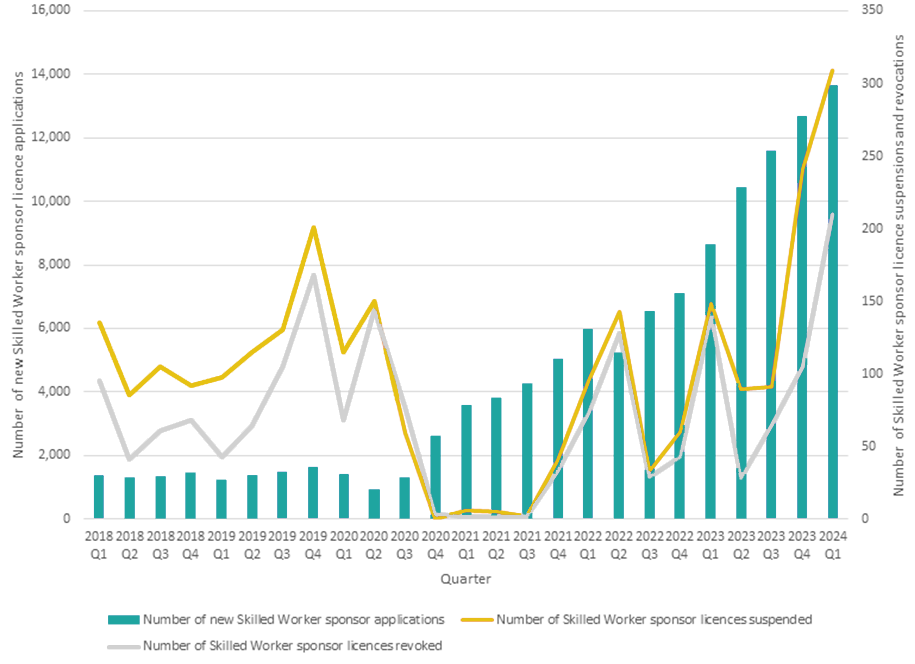
More and more employers, big and small across the country are deciding to apply for a sponsor licence to help them recruit the people they need. The April 2024 increases to Skilled Worker salary thresholds will not stop employers relying on the Skilled Worker system when they can. The reduction in the number of student and care worker family members is a further unknown/unmonitored factor in recruitment problems – as many dependent family members are themselves filling crucial roles.
As shown in the graph, the amount of UK Visas and Immigration (UKVI) compliance activity has also been increasing, although not at the rate expected given the increase in the number of sponsors. In the first quarter of 2024 there were 309 sponsor licence suspensions and 210 revocations.
As the data shows, once a sponsor licence is suspended based on UKVI allegations of breaches in sponsor conditions, it can be difficult to persuade UKVI the licence should not be revoked. The best policy for sponsors is to ensure ongoing compliance at all times.
Hopefully an incoming government will recognise the importance of overseas workers in filling skills gaps in the UK and not seek to put scoring political points above the needs of UK employers.
Kingsley Napley does not endorse any political party.
If you have any queries in relation to the above issues or any other immigration matter, please contact a member of the immigration team.


Since 2024, the Kuwaiti authorities have been undertaking a systematic review of nationality files, resulting in the revocation of nationality from reportedly tens of thousands of its citizens to date. Despite outcries from the international community, the campaign is showing no signs of slowing down. For many former Kuwaiti citizens now living in the UK, the loss of nationality is extremely unsettling, and raises significant immigration and legal complications.
This blog explores the immigration and nationality options that may be available to those affected.
With lots of students finishing their exams at this time of year, we often receive queries from hiring teams, looking to understand the Student visa category and how these candidates could transition into longer-term roles.
We set out below the different stages at which a Student visa holder might be hired, and how this impacts their right to work and the future process to join the business longer-term.
Comments from Chancellor Rachel Reeves in January at Davos have materialised into two new schemes to attract more high-growth businesses to the UK.
Announced as part of London Tech Week, the two new ‘concierge service’ schemes include visa fee reimbursements and a fast-track for Office for Investment-backed overseas businesses.
These schemes are announced as migrants, employers and prospective inward investors continue to hold their breath over whether the government will follow through on its drastic earned settlement proposals, as early as this Autumn. Uncertainty is exacerbated by the possible leadership contest in the near future which could mean a change in direction on immigration policy.
The start of Pride Month in the UK provides an opportunity for immigration lawyers to reflect on the challenges facing LGBTQ+ asylum-seeking clients.
Still fresh in our minds is April’s BBC investigation, which suggested the existence of a shadow industry of legal advisers encouraging migrants to falsely claim to be gay in order to make asylum claims that would enable them to remain in the UK. While allegations of abuse of the asylum system should be investigated, the way sexuality‑based asylum claims are discussed in public debate matters. Focusing on isolated examples of alleged abuse risks misrepresenting how these claims are actually assessed and reinforcing assumptions that cause real harm to LGBTQ+ people seeking protection.
This type of reporting raises concerns as it obscures the reality of the system. It exaggerates the prevalence of fraud and risks embedding a culture of disbelief that already presents significant barriers for genuine claimants.
One question clients often ask is whether an employer can lawfully pay a sponsored worker more than a non-sponsored worker doing the same role, particularly given the increases to minimum salary thresholds under the Skilled Worker route.
The Migration Advisory Committee (MAC) wants to know what needs to change for the UK to be competitive about attracting Global Talent.
The MAC has launched a call for evidence on the Global Talent and Innovator Founder visa routes. The deadline is 11:59pm on 1 May 2026. Here's why this matters - and why you should respond
Historically, a non domiciled divorcing couple have been able to mitigate their UK tax liabilities when making a lump sum payment to the other party to the divorce. Following guidance from HMRC in 2025, however, it seems that this particular tax mitigation strategy is no longer available and advice needs to be taken in respect of each party’s tax status, the timing and mechanism of payments and the likely tax liability.
The UK government’s new “earned settlement” proposals reveal a stark divide in how people can secure their right to live permanently in the UK. For EU, EEA nationals and Swiss nationals and their families who were living in the UK before Brexit, the EU Settlement Scheme increasingly seems a beacon of fairness. For everyone else, the future looks far less certain—and much harder.
The UK Government’s Earned Settlement consultation proposes a fundamental shift in how migrants achieve Indefinite Leave to Remain (ILR). Instead of a time-based system, settlement would be earned through measurable contributions and integration. For the tech sector—one of the UK’s fastest-growing industries—these changes could have far-reaching consequences.
As I mentioned previously, I am still trying to get my head around the issues that continue to arise from the recent announcement made by the Home Secretary in relation to the settlement provisions. For now, I want to unpack one part of the change.
The Border Security, Asylum and Immigration Act 2025 (which has just completed the parliamentary process by receiving Royal Assent on 2 December 2025) will introduce significant changes to right to work checks. The law hasn’t been implemented yet but employers need to be aware of the implications.
The Immigration Skills Charge (ISC) will increase by 32% from £1,000 per year of the visa to £1,320 per year of the visa. For small sponsors the ISC will increase from £364 to £480 per year.
The immigration policy white paper was released on 12 May 2025 and there were subsequent Skilled Worker rule changes on 22 July. On 14 October the Home Office released a statement of changes to the Immigration Rules setting out further upcoming rule amendments flowing from the white paper. There was also a Home Office press release.
We focus here on two updates - one on travel to the EU and one on the Temporary Shortage List for Skilled Worker applications based on lower skilled roles.
I’ll acknowledge, it is a little edgy - in the current climate - to argue for a more nuanced approach to historic criminality in the immigration system. Sounds like the sort of thing that would feed a tabloid journalist with everything they think they need to know about an immigration lawyer.
The issue of indefinite leave to remain (ILR) has been a hot topic in the UK press. The Reform Leader Nigel Farage has suggested that his party would abolish the status and force people with ILR to return to some form of lesser immigration status which would block access to a range of rights which those who obtained the status acquire - access to welfare benefits, free NHS care and home student University fees for young people.
From UKVI’s published statistics on immigration applications, in the most recent reported quarter (March to June 2025) UKVI received 938,527 visit visa applications – the highest ever reported in at least the last 20 years. In that quarter, UKVI also refused 156,659 visit visa applications (and issued 790,708 visas), unsurprisingly, also the highest number reported. The refusal rate for this quarter (which will not cover all applications received) was just shy of 20%.
The Secretary of State for the Home Department (“SSHD”) Yvette Cooper has trained her crosshairs squarely on foreign national families in her recent announcement, declaring the suspension and reform of the refugee family reunion scheme and a review of “the application of Article 8 in the immigration and asylum system.” The suspension came with a statement of changes to the Immigration Rules today at 3pm.
UKVI can issue a whopping fine of up to £60,000 to a company that is alleged to have employed someone illegally in the UK. The size of the fine is partly determined by whether the breach is a first for the business or not.
Oliver Oldman
Emma Fowler
Tim Richards
Skip to content Home About Us Insights Services Contact Accessibility
Share insightLinkedIn X Facebook Email to a friend Print